He Won't Call You First. He'll Google.
A Vocation Director's Guide to Being Found When Young Men Search
A young man begins to wonder what God is calling him to be, but he’s nervous to say it out loud, especially to a vocation director.
So, instead, he opens a search window...
- How do I know what God is calling me to be?
- How do I know if God is calling me to be a priest?
- Do I need to be certain before I contact someone?
- Am I holy enough for this next step?
- What happens if I reach out to a vocation director?
The search bar offers a low-pressure place to explore questions that may feel too personal, uncertain, or intimidating to ask face-to-face. He can ask without being seen. He can close the tab without being followed up with.
Which means the most important conversation in your vocations ministry is already happening — and right now, someone else is answering.
That's the challenge. It's also the opportunity: you can become a trusted voice in his discernment before the first meeting ever takes place.
Answering the Questions Beneath the Search
The answers Google provides don’t appear by accident. Search engines peer across webpages they can access to surface content that is relevant and useful to the question being asked.
That means the articles, FAQ pages, videos, and other resources published by a diocese can become part of a discerner’s search, especially when they use language he actually use.
A blog titled “Do I Need to Be Certain Before Contacting a Vocation Director?” creates a clearer connection to that private concern than a general page titled “Discernment Resources.” A direct answer near the beginning of the article helps the reader quickly recognize that he has arrived somewhere that understands what he’s asking.
This is exciting because it means that if you make thoughtful, trustworthy answers available in places where young men are already looking for them, they will find them, and by extension, they will find you naturally.
Listen for the Question Behind the Question
A discerner may appear to be asking for information, but there is often a deeper concern underneath.
What he searches... |
What he's really asking... |
| "Do I have to be certain?" | Will reaching out commit me to something? |
| "Am I holy enough?" | Could God really be calling someone like me? |
| "What's seminary like?" | What would I have to give up? |
| "How do I tell my parents?" | Will I lose the people I love? |
Strong content answers both — the practical question and the fear beneath it. Miss the second one and the first answer, however accurate, won't move him an inch.
This is the heart of strategic messaging for vocations: speaking to the man, not just the query.
Make the First Answer Clear and Reassuring
Begin with a direct answer. Use familiar language. Name the concern. Then make the next step feel approachable.
When that answer comes from the diocese or vocation office itself, it does more than inform. It introduces the ministry’s voice. It introduces your ministry's voice. If it reads as honest, compassionate, and free of pressure, he starts to believe this is a safe place to bring his questions in person.
The goal is not to complete someone’s discernment online—it’s to help him feel understood enough to continue it in relationship with Christ and His Church.
Turn Your FAQ Page Into a Growing Content Engine
Your existing FAQ page is an excellent place to begin. One thoughtful answer extracted from your FAQ can become:
- a blog post that explores the question more fully and gets found in search
- a short authentic video featuring a priest or seminarian (this is where storytelling does the heavy lifting)
- or a social post, carousel, or poll that meets him where he already scrolls.
Each format creates another path to the same helpful answer — a blog found through search, a video encountered on Instagram, a link forwarded by a pastor or a mother. Together, they make the vocation office visible and trustworthy long before the first conversation.
One question. Three assets. Repeat monthly, and in a year you have a library that works while you're on the road doing parish visits.
Always Offer a Human Next Step
Every answer should open a door.
Invite him to ask a question, schedule an informal conversation, attend an event, or simply learn what happens after contacting the vocation office.
The invitation should make one thing unmistakably clear: reaching out is not a declaration. It is simply another step in listening to God.
Communication is not only the transmission of information, but it is also the creation of a culture, of human and digital environments that become spaces for dialogue and discussion.
Frequently Asked Questions from Vocation Directors
How do I get my diocesan vocations page to show up in Google searches?
Publish pages that answer specific questions in the exact language discerners use, put the answer near the top, and give each question its own page rather than burying them all under one "Resources" heading.
Isn't digital outreach impersonal?
For this generation, online is often where the relationship begins, before he ever walks into your office.
I don't have time to produce content. What's realistic?
Start with one question per month, sourced from your FAQ page, and repurpose it across three formats. Most offices don't need more time — they need a system and a partner.
How do I justify the budget to my bishop or finance council?
With data. Dioceses using this approach have seen email open rates at double the national benchmark and click-through rates 20x industry averages. We equip directors with decks, talking points, and impact forecasts so you're not making the case alone.
DO THIS:
Choose one question you hear repeatedly from young men. Write a short answer that:
- Responds directly to the question
- Addresses the concern beneath it
- Offers one clear, low-pressure next step
Then adapt that answer into a blog, video, and social post.
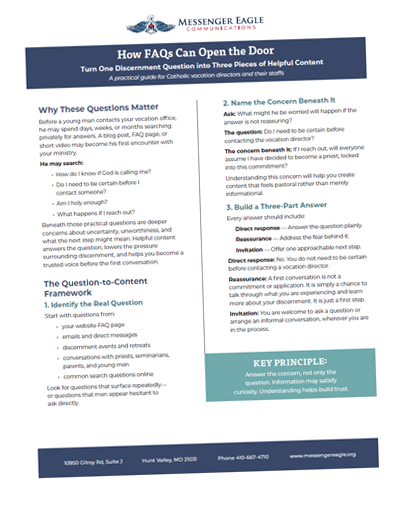
How FAQs Can Open the Door
Get our practical guide and start transforming the questions young men are already asking into opportunities for trust and connection.
Messenger Eagle Communications is an NCDVD Trusted Partner and a faith-rooted creative team serving dioceses across North America. Explore more strategy for vocation directors at The Messenger, our resource hub built for this work — or see what we've built for other dioceses.